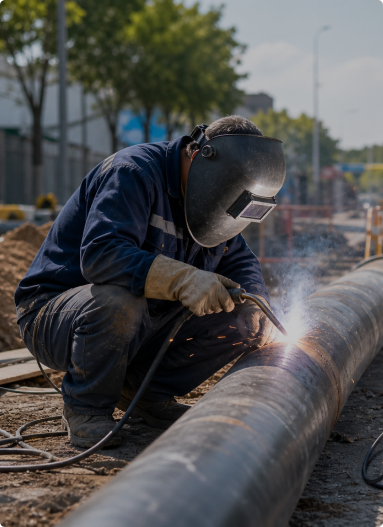
Yes, for many on-site welding applications. The ES Series combines professional MMA/TIG welding with battery-powered AC output, eliminating the need for fuel and engine maintenance. The right model depends on your welding current, workload, and required runtime.
The ES Series supports MMA and Scratch-Start TIG welding, with plasma cutting available on selected models. It is compatible with common electrodes such as E6013 and E7018, supporting diameters up to Ø5.0mm.
Welding capacity depends on the model, electrode size, and welding current. For example, the ES-6000PLUS can weld up to 876 Ø2.5mm electrodes per charge under reference test conditions.
The ES Series integrates DC welding and AC power supply functions, supporting tools such as angle grinders, drills, and cutting machines. Simultaneous operation and available output depend on the model and connected loads.
The ES Series supports AC charging, generator charging, and vehicle charging, with additional options available on selected models. Recharge in as little as 2–3 hours to minimize downtime and keep projects moving.
Battery-powered operation eliminates on-site fuel consumption and routine engine maintenance. For frequent welding and maintenance work, this can reduce operating costs, depending on electricity prices, usage frequency, and project conditions.
A simple estimate is: Load × Runtime ÷ Usable Efficiency = Required Energy. For example, 5kW × 8 hours ÷ 85% ≈ 47kWh. Final sizing should also consider startup power, reserve capacity and charging conditions.
Selected energy storage configurations support multiple energy sources including grid, solar and generators. Compatibility depends on the inverter and system configuration.
Yes, battery storage can be combined with solar. If equipment consumes 20kWh per day, the system needs to replenish at least 20kWh plus system losses each day. Solar capacity should be sized according to local sunlight, season and required autonomy.